Dymon Harris

Data Analyst
| Predictive Analytics & Process Improvement |
| Python • SQL • Data Visualization • Machine Learning |
| Turning data into decisions that reduce risk, improve performance and profitability |
View the Project on GitHub Extracted-Dee/Employee-Attrition-Prediction-Project

📉 Employee Attrition Prediction Project
🤖 Predictive Analytics & Machine Learning in HR
A data-driven project using exploratory data analysis and machine learning models to identify the key factors influencing employee attrition and predict which employees are at risk of leaving.
📌 Project Overview
Employee attrition creates significant costs for organizations, including lost productivity, rehiring expenses, and decreased morale.
This project analyzes HR employee data to uncover why employees leave and to predict attrition risk using machine learning models.
🎯 Project Objectives
- Identify the key drivers of employee attrition
- Build predictive models to classify employees as likely to stay or leave
- Provide actionable, data-backed recommendations to reduce turnover
🗂 Dataset Description
Dataset: HR Employee Attrition Dataset
The dataset includes employee-level attributes such as:
- Age
- Job Level
- Monthly Income
- Job Satisfaction
- Performance Rating
- Overtime Status
- Years at Company
- Years with Current Manager
- Attrition (Target Variable)
🛠 Tools & Technologies
- 🐍 Python
- Pandas
- NumPy
- Matplotlib / Seaborn
- Scikit-learn
- 📊 Exploratory Data Analysis (EDA)
- 🤖 Machine Learning
- Logistic Regression
- Random Forest Classifier
🧹 Data Preparation
To prepare the data for analysis and modeling:
- Converted categorical variables into numerical format using binarization/encoding
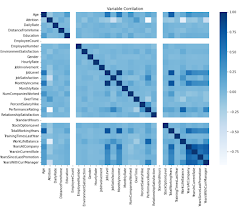
- Analyzed variable relationships using correlation matrices and heatmaps
- Removed low-impact and highly correlated variables to reduce noise
- Evaluated multicollinearity to improve model stability
📊 Exploratory Data Analysis
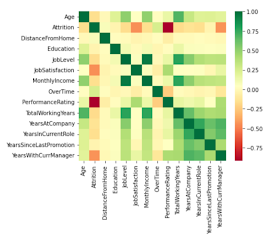
🔍 Key Correlations & Insights
- Overtime showed a positive relationship with attrition
- Age was slightly negatively correlated with attrition, indicating older employees were marginally less likely to leave
- Years with Current Manager had a negative relationship with attrition, suggesting management stability improves retention
- Monthly Income and Job Level were negatively correlated with attrition
- Career progression variables (Years at Company, Years in Role, Years Since Last Promotion) were strongly correlated with one another
These relationships highlight the importance of career growth, compensation, and workload balance in employee retention.
🤖 Predictive Modeling
Two complementary models were developed:
1️⃣ Logistic Regression
- Selected due to the binary nature of attrition (Yes/No)
- Provides interpretability for understanding feature impact
⚠️ Model Adjustment:
The Performance Rating variable caused overfitting due to an extremely strong correlation with attrition. It was removed to improve model generalization and reduce bias.
2️⃣ Random Forest Classifier
- Handles nonlinear relationships and feature interactions
- Robust against noise and complex workforce patterns
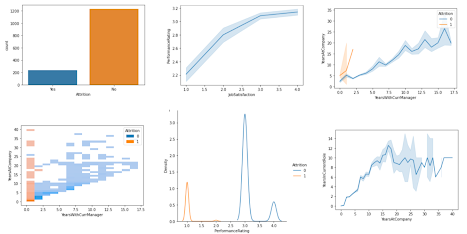
Random Forest helped uncover deeper patterns across satisfaction, tenure, compensation, and overtime variables.
💡 Key Findings
- Employees with lower income, lower job level, and shorter tenure were more likely to leave
- Overtime increased attrition risk
- Longer relationships with the same manager reduced attrition likelihood
- Career stability and progression strongly influence employee retention
Both models demonstrated that employee attrition can be predicted with meaningful accuracy using HR data.
🚀 Business Recommendations
Organizations can reduce turnover by:
- Monitoring employees with high overtime and low tenure
- Strengthening career development and promotion pathways
- Supporting consistent manager–employee relationships
- Reviewing compensation structures for at-risk employee groups
- Using predictive models to proactively identify and support high-risk employees
📈 Business Impact
This project demonstrates how predictive analytics can help HR teams:
✔ Move from reactive to proactive retention strategies
✔ Identify attrition risk early
✔ Support data-driven workforce planning
🏁 Conclusion
By combining exploratory data analysis with machine learning models, this project shows how employee data can be transformed into actionable insights that directly support organizational decision-making.
It highlights skills in:
- Data cleaning and EDA
- Predictive modeling
- Business-focused insight generation
📬 Explore more of my projects here.